Ingredients
All-purpose flour (or 00 flour) and water in equal amounts by weight. Time and patience.
Procedure
In my sourdough recipes, “sourdough starter” will always refer to a liquid starter with 100% hydration (i.e. equal parts flour and water).
Make it
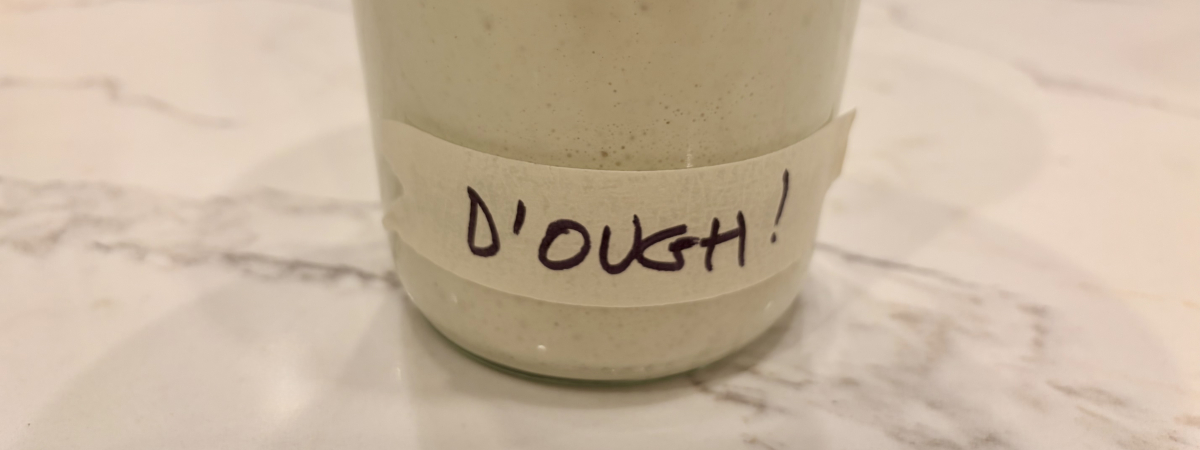
If you somehow can’t acquire starter from someone, making and maintaining your own is pretty easy. The container I use is a 3/4-liter Weck jar with a keep-fresh cover—you do not want to hermetically seal your starter in a glass jar, because it will explode. Notice the boldface there.
Here’s how you do it:
- Mix 50 g of water and 50 g of flour
- Cover and let it rest for 12 hours
- Mix 50 g of water, 50 g of flour, and 20 g of starter. Discard the remaining spent starter
- Cover and let it rest for 12 hours
- Repeat 3 and 4 for a few days, until finally the mixture starts doubling in volume within a few hours from its last feeding
You’ll want to replace the jar with a clean one every couple of days, to prevent bad yeasts and bacteria from forming around the sides and taking over before the good stuff is strong enough.
Keep it
A strong starter is resilient. If you keep a strong starter at room temperature you can neglect it for several days, and it will come back within a couple of feedings. You can neglect it for weeks, and it will still come back. If you plan to bake daily or almost daily, feed it every 12 hours (points 3 and 4 above). If you’ve neglected it, feed it a couple of times before you use it.
If you’re not planning to use it for a while, you can refrigerate it and it will come back even after a couple of months. You can also freeze it, and it will become active again a couple of days after defrosting.
But generally, a healthy starter should be a pleasant cream color, and will stick to a spoon when stirred. A neglected starter will become progressively more liquid and runny, and will veer toward some shade of gray. After a few days of neglect, it will start developing a layer of alcohol on top—that’s totally fine, and it can be mixed back in before a feeding to maintain the hydration level.
More weeks of neglect will produce various other colors, from yellow to pink. I was always able to bring a pink starter back to life after a couple of days. Once a pink starter develops blue mold spots, that’s when I would call it dead—or at least when I would make a new one.
Use it: the 12-hour starter
For years my baking schedule depended on the starter’s temperament, waiting for it to become active, fearing it would peak before I had an opportunity to use it. It wasn’t fun.
Then I started following Richard Hart’s 12-hour starter technique, which allows me to be much more in control of my baking schedule. It boils down to:
- Make sure your starter is active, with at least a couple of days of regular feedings. It should happily double in volume within a few hours after feeding
- The day you need it, feed a separate batch with 100% flour, 100% water (40°C), and 40% starter (those are baker’s percentages). The percentage of starter and the temperature of the water might vary according to the recipe, and the actual amounts will depend on how much starter a recipe needs, and how much leftover you want
- Let the starter rest for about 45 minutes. It will not double in volume, but you will notice obvious activity, and it will do its job