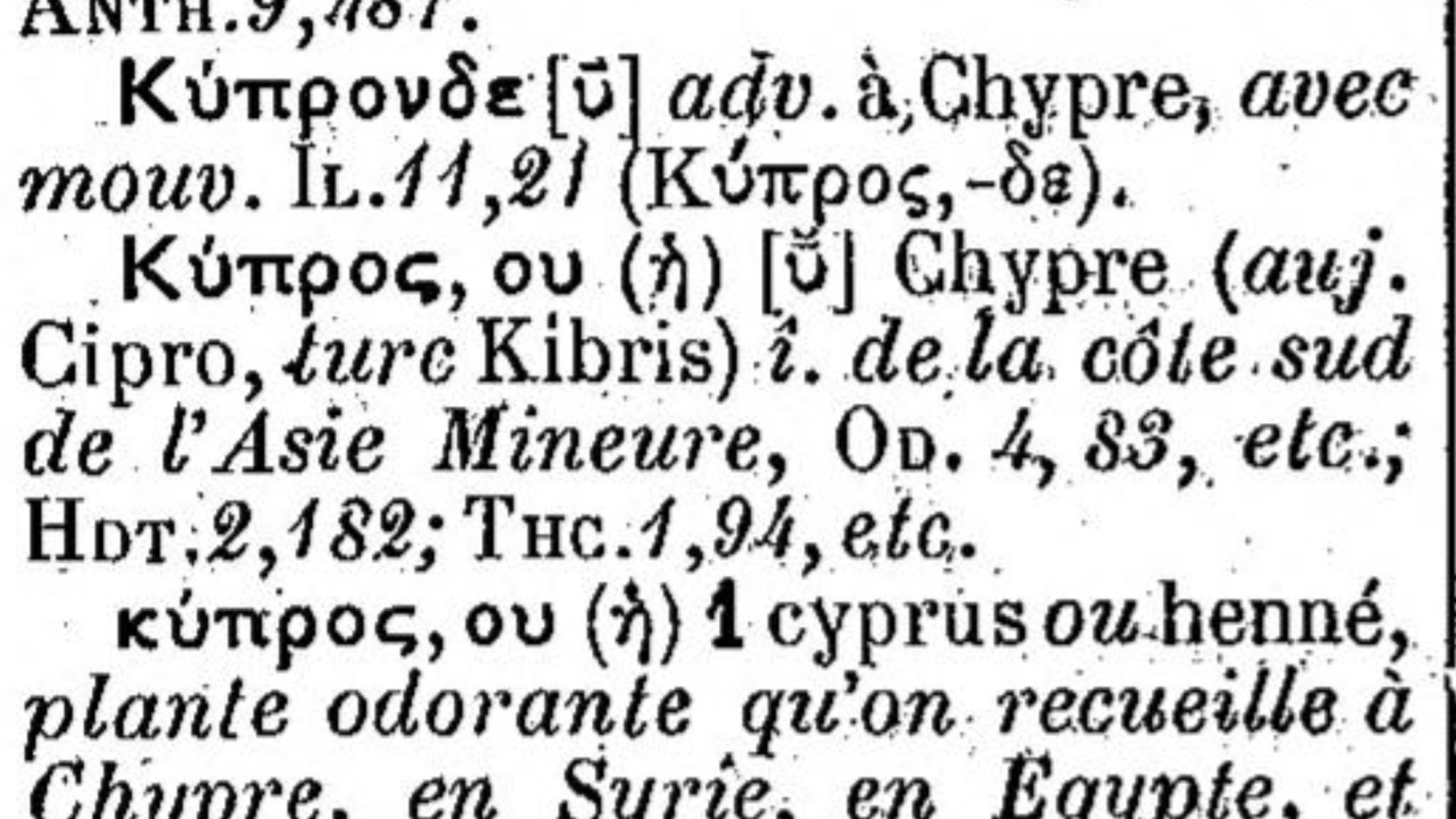
Yesterday I learned—or relearned, as that’s more likely the case—that Cyprus is feminine in Greek. The fact that the noun belongs to the second declension in the old language and in Latin could have fooled me, and I guess it’s not something I’ve had to think about in a while.
What about Italian then? To quote Wikipedia, “Cipro è […] divisa de facto in due parti separate dalla cosiddetta linea verde”—that divisa is what’s alerting us that Cipro is a feminine noun. But while that makes sense to me instinctively, linguistically I need to do some more digging.
Italian tends to normalize as masculine most masculine-looking nouns, particularly those that have an -o ending, and the second- or fourth-declension Latin nouns they come from, even when they’re not originally masculine or neuter. The most blatant example is that of fruit-bearing trees, which in Latin are second-declension feminine nouns and are a Latin teacher’s favorite instrument of torture: declining malus alta (the tall apple tree) will always trip up Italian students. Italian turned the feminine malus into the masculine melo and simplified everyone’s life.
The most obvious exception to that general rule is la mano (the hand), which retains the feminine gender of its Latin ancestor, manus, a fourth-declension noun. Instead of freaking out at this apparent misgendering by refusing to change the ending in the plural, Italian treats this noun the same way it treats all Latin fourth-declension masculine and neuter nouns, and normalizes it to the second declension: le mani. Someone may teach you it’s an exception, but it’s one of the most regular things Italian will do.
(But don’t ask me why the heck l’ala, the wing, is pluralized as le ali, because that’s just bonkers.)
Other feminine names with -o endings are mostly abbreviations, like la foto (the photograph), la moto (the motorcycle) or la metro (the subway), which by definition don’t change in the plural. A Greek-derived word like l’eco (the echo) is originally feminine but can be either feminine or masculine in Italian, and is stupidly, maddeningly always masculine in the plural: gli echi, also normalized as a second-declension noun, despite it being a weirdo third-declension noun in Greek. Other Greek feminine second-declension words are normalized as masculine, such as the derivatives of ὁδός: il metodo, il sinodo, l’esodo (I promise this last one is also masculine). An exception is la parodo, which is technical and academic, and apparently can also be masculine, and for whatever reason doesn’t change in the plural when it’s used as a feminine. I’m gonna start flipping tables here.
The other big class of feminine nouns that have masculine-looking endings are city names. Bergamo, Bolzano, Palermo, Torino, Trento, Treviso, but also translated foreign cities, like Belgrado, Berlino, Dublino, Monaco (that’s Munich, by the way, not that other place with the same name): Italian declares that they’re all feminine, regardless of their origin, because, I assume, la città is feminine. And just to blow everyone’s minds, Il Cairo, with that masculine article, seems to want to be gendered as masculine, but I’ve found plenty of examples where it’s declined as feminine, despite explicit grammatical rules, because the Italian brain just refuses to consider city names as anything but feminine.
When it comes to the genders of countries, Italian is fairly predictable, and tends to follow the country’s gender in its original language, when possible. But generally, if the name has an -o ending it’s masculine, and if it has an -a ending it’s feminine. And if it ends in a different vowel or a consonant it’s most likely also masculine. And if it’s exotic (for lack of a better term) it’s a toss: la Nigeria and la Tanzania, but il Kenya and, shockingly, il Sudafrica, despite Africa being feminine.
My quarta ginnasio teacher of All The Things said that when it comes to a word’s accent there’s no rule: the word is just born a certain way, and you just have to learn it. Same for the gender of things—at least those that don’t have gonads. (And I’m not here to question whether that’s the proper approach in the contemporary world, so don’t @ me.) Given my fixation with etymology and the origin of languages, I never truly accepted that. In any case, the Greek gender of Cyprus is what it is because it’s what it is, right? But I don’t think its gender in Italian is what it is just because that’s what it is in Greek.
Latin had this thing where cities and small islands were special, and didn’t need prepositions when they were treated as locations. To say “in Rome” you wouldn’t say in Roma, but you would use the locative Romae. (Domus, the home, also got a similar treatment—but that’s a special word in English too.) On the other hand, large islands (namely, Sicily, Sardinia, Cyprus, Corsica, and Crete) were treated as regular nouns, and received all their prepositions as expected.
Italian doesn’t have locative cases, but it does seem to retain this distinction between large and small islands, and treat large islands the way it treats countries: they’re often preceded by the definite article, and their locative preposition is in, usually without the article. Cities, on the other hand, don’t get the article (unless it’s part of the name itself—long story), and their locative preposition is a.
So we say la Sicilia è bella (Sicily is beautiful), and vado in Corsica (I’m going to Corsica. No article here, but look at that in), just like l’Australia è lontana (Australia is far) and vivo in Portogallo (I live in Portugal). Compare that with Torino fu la prima capitale d’Italia (Torino was the first capital of Italy) and mia zia abita a Bologna (my aunt lives in Bologna. She does, by the way).
However, this behavior stops at islands that are in the immediate vicinity, because we’d say vado a Creta and abito a Cipro—which is even more surprising, since Cyprus is not only larger than Corsica, but also a country. What’s up with that?
I don’t know what’s up with that. My suspicion is that Italian has a hard time categorizing things that aren’t large enough, or small enough, or, perhaps, close enough—culturally, if not geographically. That would explain why Malta (despite being closer to Sicily than the Italian island of Lampedusa, which in turn is closer to Tunisia than it is to Sicily) gets the city treatment even though it’s a country that’s not an individual small island: no article, and the preposition a—Malta è vicinissima alla Sicilia, vado a Malta. It doesn’t quite explain why San Marino gets the city treatment (except maybe by way of synecdoche), since it’s just so obviously close to Italy you can see it sometimes, if the sky is clear and, well, if you’re in the right part of the country.
Maybe it’s a way to minimize a place that the culture doesn’t consider important enough, even if it’s both a large island and a country. We’ll never truly know. But I might just start saying “la Cipro fa parte dell’Unione Europea” (or is it il Cipro? Who even knows anymore) and “vorrei andare in Cipro un giorno” and see if my compatriots think that I’ve finally, completely lost it.