On June 1, 1989 I woke up in the United States for the first time. The day before, my mom and I had flown from Milan to Los Angeles, then to San Francisco—my first flight was a twelve-hour affair locked in a Boeing 747.
Alitalia flight 620, back then, went from Rome to Los Angeles with a stop at Milan Malpensa. My mom and I were sitting in the middle of the plane, central on the left aisle. The two center seats to my right were empty, and my mom immediately taught me it was our right to occupy them as soon as we were in the air. The American family sitting in the row before us had boarded in Rome. Maybe it was because they had two small kids, but it looked as if they’d already been on that plane for a month or so. Right after takeoff, the dad and a daughter, who must have been three or four, decided that it was their right to occupy our neighboring seats. The dad then proceeded to spend much of the next twelve hours with his daughter sleeping on his lap, nonchalantly occupying not only the two extra seats but also part of mine, as her curly red hair was flowing over my armrest.
I’m not sure at which point my mother realized how crazy the whole thing was. Now that I’m older than she was back then, I have to wonder when that happened. I also don’t know when she first had the idea. Perhaps it was six years earlier, at the tail end of her month-long cross-country bus-and-tent trip to the United States. (She failed to inform the family that tents were involved until she came back.) I imagine her sitting in that bus, crossing the Bay Bridge on a spring day, one of those when the rains have stopped and the fog is already playing its daily tricks. I imagine her taking a first look at San Francisco through her window, and her whole plan just unraveling before her eyes. In due time, she’d make it happen.
San Francisco was fucking stunning back then. You’d see it, and you could imagine moving there, living there, breathing that air every day, and that would be it. Today, not so much. But this is not about today—it’s about that moment I’ve never asked her about, when my mother decided what my life would become. She’s always been good at that—it’s her gift and her curse, some might say.
I don’t know if everyone has a favorite flight. My favorite isn’t the one that was my first, too noisy and smelly and with too many red curls flooding my armrest, but the next one. While I remember almost nothing about that day at LAX, my memory comes back when our much smaller, emptier Delta plane takes off around sundown, flies briefly over the Pacific Ocean, and lands at SFO after dark. The two things I learned on that flight were that American soda cans opened differently from European ones (until Europe caught up a couple of years later), and that somewhere in San Francisco stood a building shaped like a pyramid. Apparently I was already the guy who left home without doing a shred of research.
Perhaps the moment she realized it was all a crazy mistake was right after we grabbed our bags and stepped outside, on the chilly sidewalk at SFO. That was the moment that could have made or broken the whole plan. It was all about whether a certain Volkswagen Golf would be there to pick us up. Too late to turn back now, regardless.
Months earlier, I sat on the floor in our apartment’s entryway, with my back against a closet. I was holding my math notebook, on whose final page was a list of the world’s time zones, relative to ours. I’m not sure why that was relevant information in a math notebook, but the unknown designer who put it there was about to have their moment of glory. My mom had been wondering how appropriate it would have been if she’d made the call right then. 6:00 pm in Italy, 9:00 am in San Francisco—that’s what the notebook said. The call she was making was to her friend’s friend (whom I’ll call Norma), who had lived in Italy and couldn’t come back, at least not for a while, because her divorce from an Italian man wasn’t final, but she was already married to an American. That’s how they rolled in America, obviously.
It so happened that Norma was a librarian at Stanford who occasionally taught English as a second language at a school in Palo Alto. Those were all names I hadn’t heard before. I knew California and San Francisco, because I’d seen pictures and posters my mom had brought back from her previous trip, and because she kept talking about them. She also talked about New York a lot, but for some reason that’s not where she’d left her heart. The call set the plan in motion. Then came the travel agent, the plane tickets, and lots of faxes—all to make sure Norma and her Golf would be waiting for us that night.
I was finishing seventh grade that year, and my mom had decided that I could do without the last ten days of school. I didn’t think it was her style to decide something like that, but presumably taking off at the end of May would have cost less than being away smack in the middle of the summer. The plan included a month of English school for both of us, then two weeks of traveling in Southern California and Nevada, after my dad joined us.
I’d never formally taken English before then. We had a course on tape that was, in retrospect, somewhat useful, but I had established that the language was impossible to learn. In previous years mom had done conversation with a woman from California who was an au pair in our town. I always played dumb and my lips were tightly sealed any time English was involved. One time I agreed to recite the alphabet, and I remember stopping before Z, because I’d learned it the British way, and I knew that was not the way Americans said it, so I said nothing. I pretended not to know, when I could have shown off. But what if that one thing I knew had been wrong? It would have been disaster and ridicule.
That very first morning in Palo Alto I suffered through an awkward conversation with Norma’s half-Italian son and her husband’s fully American son, during which I felt annoyed and jealous that a six-year-old could switch between two languages so easily. Later, Norma drove us to what would be our permanent residence for the next four weeks. If her University Avenue apartment had made our morning so smooth I barely remember having any sort of jet lag, the outside world was a slap in the face.
El Camino Real was wide, crowded, and very sunny. It took me half a second to notice all the things that were different from Italy, from the shapes of the buildings to the way road lanes were painted, to the fact that traffic lights were on the far side of intersections. I probably thought it was the stupidest thing I’d ever seen, while realizing very well how much sense it actually made. In school I’d learned that the distinctive feature of urban California was sprawl rather than height, and I could finally confirm that. Norma would keep saying “Well…” even though she was speaking Italian, and point to things so quickly we could barely register them: “That’s the Stanford Shopping Center, that’s California Avenue where the school is, that’s Page Mill Road, where you can take the 7F bus to San Francisco, those are restaurants, that’s a supermarket”. All of that ended in front of a single-story house in a quaint residential street, where the ongoing drought had devastated most gardens and left them for dead.
When you’re a kid there are only very few key people that aren’t part of your family. I mean the kind of people who end up shaping the way things go in your life, and the way you think about the world. The moment she welcomed us through her front door, I had no way to predict that Sheila Mandoli would be one of those people for me. Over the following few years she’d come visit us in Italy, I’d stay at her place a few more times, and she’d find us accommodations when she couldn’t host us. She’d pick me up at the airport, drive me around the Bay Area, take me out to dim-sum, and pretty much make me part of her own family.
But on that day even the most refined gift of foresight would have been overwhelmed by my lack of a language to speak and by all the differences I kept spotting between that world and the one I’d grown up in—the power outlets, the doorknobs, the amount of water in the toilet bowl, and the smell of everything. Water smelled differently, and so did toothpaste, sugar, milk, garbage, stores. Houses smelled differently too, and not just because of the food that people made, but because—and it took me years to figure it out—the earth had a different smell there. I didn’t like it one bit, but I loved it.
The first night we were at Sheila’s house, still demolished by jet lag, we decided to go to McDonald’s. I’d eyed it on the way there that morning, and I’d nagged my mom all day until she agreed to take me. It was basically around the corner, just a few blocks away, surrounded by thick hedges of star jasmines. Except, of course, McDonald’s wasn’t around the corner. I now know that it was about one and a half kilometers from Sheila’s house, but to the two of us, very ill-equipped to brave the sidewalks of El Camino at the end of a hot day, it looked like it was always beyond the horizon. What was even worse was the idea that after finally finding it we’d have to walk all the way back. I can close my eyes and feel exactly how tired I was, how hot the air was, and how much I hated the smell of those jasmines, a smell like I’d never smelled before, pungent and sweet, alive and rotten, violent and welcoming. Over the next four weeks I’d get used to walking that stretch, and not even that odious smell could keep me away from what I thought was the essence of American living.
So I was in level one at Language Pacifica, four rooms in a boring office building that smelled like dusty carpet, instant coffee and stale microwaved food. With me in level one was a handful of Japanese girls who looked my age but were actually in college, and who produced unusual sounds of what I understood as extreme surprise when they found out I was twelve and not, I suppose, sixteen.
The school had no term, no start and no finish. You’d drop in on a random day and you’d pick up wherever everyone else was. In the four summers I attended I never went through a whole textbook. I was dropped into level one on a Monday, and it was immediately clear to me that I’d never understand a thing, I’d never learn any of the words, I’d always be stuck at level one, always stubbornly unable or unwilling to finish the alphabet. At the first break I went to my mom’s level-two classroom, where everyone seemed to be knowledgeable and cool and at ease, and told her I’d never make it. She laughed and told me that two hours wasn’t enough to make that judgment. But her teacher, Veronica, was nice and all smiles, while mine, Karin, was cool and stern, and kept pronouncing my name in a way that had to do with her being fluent in Spanish, and I didn’t like that.
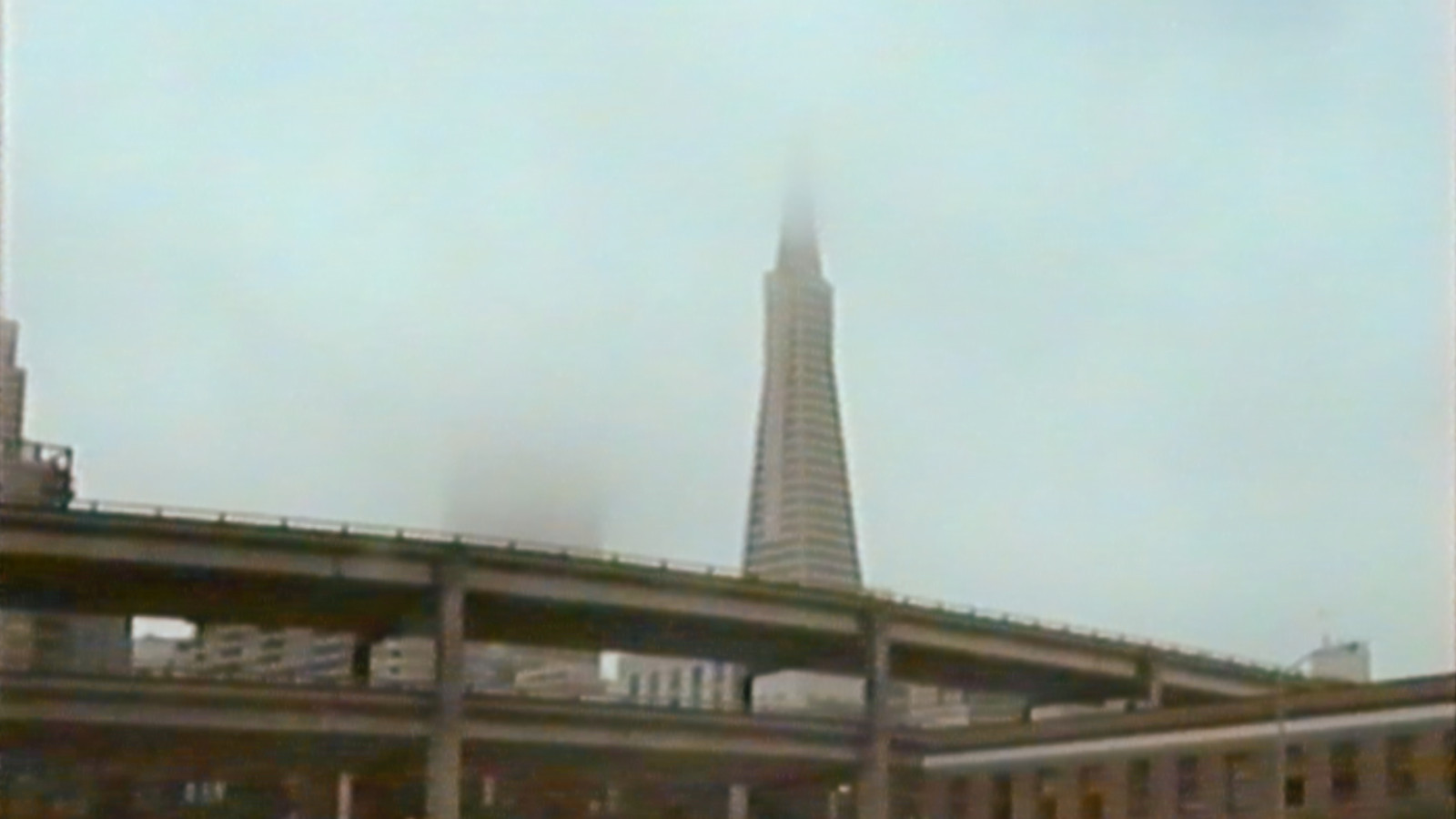
If I’m making it sound like I hated everything it’s not because I actually did. At first I may have been constantly overwhelmed by everything that didn’t exactly correspond to my experience of the world thus far. But the reality was that I loved pretty much everything, because it was so different. San Francisco made absolutely no sense, and I loved it. Buildings cut off by fog. Uncanny chill in the middle of June, at least fifteen degrees lower than in Palo Alto. Ugly elevated highways that ended in the middle of nowhere. This shiny city dipped in water was nothing like I’d seen before. I dreamed of being one of the shirtless runners on the Embarcadero, because I imagined that if you were able to do something like that in a place like that, you’d have nothing to fear. In spite of all the ritual walks I’ve taken since then on the Embarcadero, I’ve never actually gone for a run there, with or without a shirt on.
By the end of the month I swore I’d never have any English teacher other than Karin. I promised I’d be back in two years, and that she’d be my teacher forever. Predictably, I was wrong: I was back the next year, and as it turned out I never saw her again. When I left all the Japanese girls cried, I cried, we promised to stay in touch, and for some time we did. Norma, whose Golf had been in the right place at the right time, stood us up a couple of times, and became barely more than a name in our family lore. Sheila, on the other hand, became family, and for the next two decades she would tease me about the styrofoam Big Mac box full of ketchup packets she found in our room when we left.