Ingredients
Yields 12 bagels.
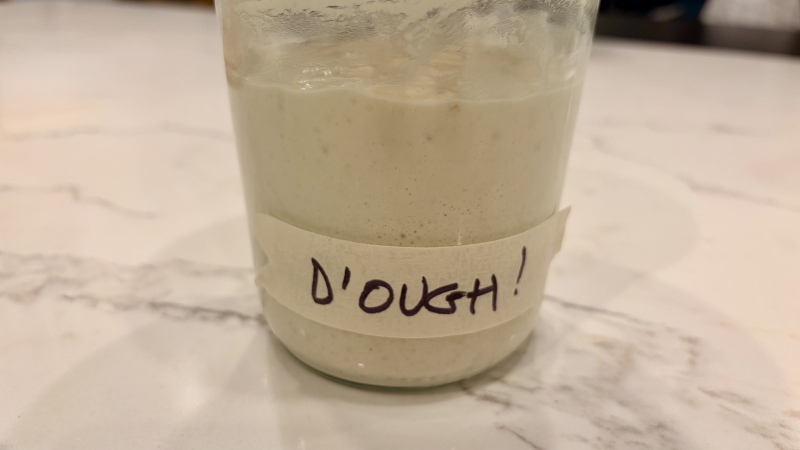
Starter
- 100 g water, 40°C
- 45 g 12-hour starter
- 100 g all-purpose flour
You will use only 90 g of this in the dough (see below).
Autolysis
- 600 g bread flour
- 300 g water, 40°C
Salt prep
- 10 g sea salt
- 75 g water, 40°C (or just hot enough to dissolve the salt over the course of a half hour)
Dough
- 315 g bread flour
- 100 g water, 40°C
- 90 g starter
- 1 tablespoon honey
Boiling
- 3 l water in a pot
- 25 g sugar
- 5 g baking soda
Toppings
- 2 eggs
- toppings of choice, such as
- sesame seeds
- poppy seeds
- dried onion flakes or chives
- garlic powder
- sea-salt flakes
- chili flakes
Additional, to help with procedure
- olive oil
- semolina
- water, room-temperature
Procedure
Day 1
Starter
Mix water, 12-hour starter, and flour, and rest in a proofing drawer or in a warm spot. The starter will probably not increase in volume much, if at all—but that’s okay.
Timer: 45 minutes.
Autolysis
In a stand mixer with the hook tool: mix water and flour until they come together. The mix will look rough. Cover with a damp cloth and rest in a proofing drawer or in a warm spot until the starter timer goes off.
Salt prep
Mix salt and water in a bowl, and set it aside.
Dough
At the end of the 45 minutes, add to the mixer bowl with the autolyzed mix:
- the 40°C water
- the salt water, which shouldn’t be warmer than 40°C
- the honey
- the starter
- the flour
Mix at medium speed for 5 to 10 minutes, until the dough is smooth and pulls easily off the sides of the bowl.
Transfer to a sealable container (possibly made of glass), lightly oiled. Alternatively, cover the bowl with a damp cloth.
Proof for 5–6 hours in a proofing drawer, or in the oven with the light on for 2–3 hours, then refrigerate for another 2–3 hours.
The dough will be ready when it’s doubled in size, and will not spring back when poked with a finger.
Prep the work surface
Dust your work surface with semolina. Have a bowl with a small amount of semolina on the side, and a bowl of room-temperature water. Keeping your hands slightly damp will prevent the dough from sticking too much, and will give it the right amount of friction against the work surface. The semolina will help in the opposite direction.
Weigh and pre-shape
Transfer the dough onto the work surface, and divide into 12 pieces of about 126 g each.
Without putting too much pressure, roll each weighed piece onto itself, then turn it 90° and roll it again in the cross direction. Leave the rolled-up pieces on the work surface dusted with semolina, and cover with a damp cloth.
Timer: 15 minutes.
Shape
Line a baking sheet with parchment, and dust it with semolina.
I am no Celestino, but I stand by (an approximation of) his rolling technique, because it helps avoid the bagel holes becoming too small as they proof, compared to poking balls of dough with your finger.
Roll out each piece of dough into a “sausage” of about 20–25 cm, with tapered ends. Wrap it around your hand, with the ends overlapping by 4–5 cm, then roll it on the work surface to make the ends adhere. The shaped bagel should be fairly uniformly thick, and it’s okay if the surface looks slightly twisted—that will get smoothed down during proof.
Place the shaped bagels on the prepared baking sheet. Lightly dust with semolina.
Shaping 12 bagels should take about 20 minutes. Cover with a damp cloth, then rest at room temperature for an hour. The dough should look relaxed and might start showing some bubbling under the surface. Adjust the rest time according to the temperature.
Refrigerate, possibly overnight, for 10–12 hours.
Day 2
Mise en place
- Pre-heat the oven to 220°C, static
- Take the bagels out of the fridge and leave them covered
- Crack the two eggs in a bowl, and beat them well
- Pour the toppings into separate bowls, or mix as desired for everything bagels
- Bring to a boil a pot with 3 liters of water
- Add sugar and baking soda to the boiling water
- Prepare a cooling rack on a baking sheet by the stove
Boil
Using a spider skimmer or a slotted spoon, transfer two bagels into the pot. Sourdough bagels will most likely sink at first. Use the skimmer to make sure they don’t stick to the bottom or to each other. Maintain a rolling boil.
Properly proofed bagels will start to float after about a minute, and they will tend to flip. Flip them with the skimmer if they don’t. Keep boiling for another minute. If it takes them longer to float, be patient. If it takes them two minutes or longer to start floating, make sure they keep boiling for another 30 seconds.
If the rolling boil turns into a simmer once the bagels start floating, adjust the power accordingly.
Place the boiled bagels on the cooling rack.
Egg wash and toppings
Once all bagels are boiled, dip each in the egg wash, covering both sides.
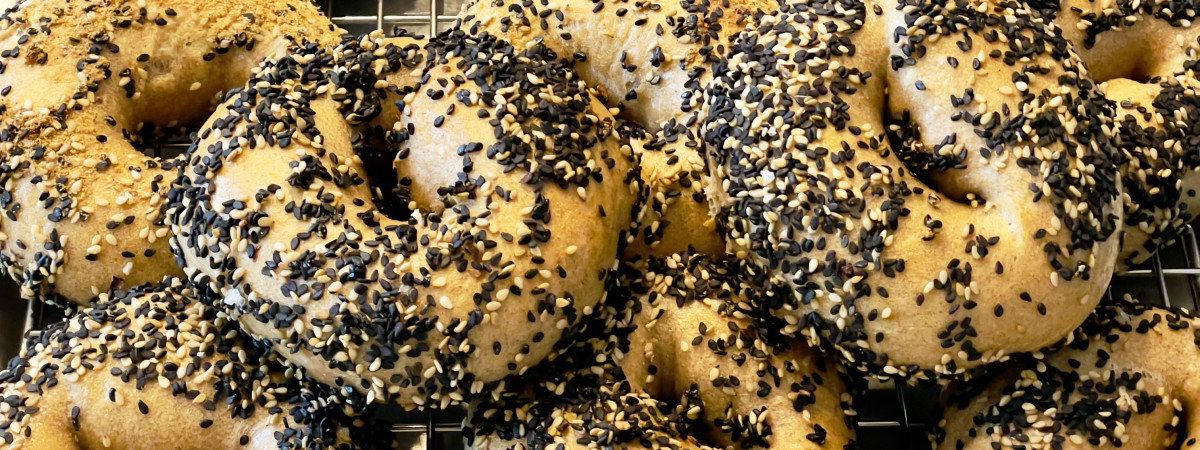
Dip each bagel in the desired topping, flipping to cover both sides. (I think a bagel with toppings only on one side is a missed opportunity, particularly when sharing open-face halves.)
Place the bagels back on the baking sheet.
Bake
Bake for 20 minutes at 220°C, until the egg wash takes a light golden color and some of the toppings start to char.